John J. Camilleri
Updated: 5 March 2012
The research leading to these results has received funding from the European Union’s Seventh Framework Programme (FP7/2007-2013) under grant agreement no. FP7-ICT-247914.
This documentation is also available at the MOLTO Project Wiki.
The aim behind developing a desktop IDE for GF is to provide more powerful tools than may be possible and/or practical in a web-based environment (the GF Web IDE). In particular, the ability to resolve identifier cross-references and browse external libraries quickly during development time is one of the primary motivations for the project.
The choice was made to develop this desktop IDE as a plugin for the Eclipse Platform as it emerged as the most popular choice among the GF developer community. Support for the platform is vast and many tools for adapting Eclipse to domain-specific languages already exist. Unlike the zero-click Web IDE approach, using the GF Eclipse plugin (GFEP) will require some manual installation and configuration on the development machine. Thus the GFEP is aimed more at seasoned developers rather than the curious GF newbie.
The starting point for the GFEP is using the Xtext DSL Framework for Eclipse. By converting the GF grammar into the appropriate Extended-BNF form required by the LL(*) ANTLR parser, the framework provides a good starting point for future plugin development, already including a variery of syntax checking tools and some cross-reference resolution support. The specific requirements of the GF language, particularly in the way of its special module hierarchy, mean that significant customisations to this generated base plugin are needed.
The GFEP is being developed by as part of Work Package 2 of the MOLTO Project.
Note about Available Software Sites
In order for dependencies to be satisfied, you need to ensure that your Eclipse has the following update site URLs set:
Steps for installation
(External) you can safely delete this via the Eclipse Project Explorer. It is no longer used in GFEP ≥ 1.2.3gfep.log then you can safely delete it from your system. As of version 1.2.4, GFEP uses Eclipse’s standard log file at <workspace>/.metadata/.logAlthough the plugin should take care of your project settings for you, in case anything gets messed up you can always correct them manually as follows:
Your .project file should include the GF Project Nature as follows:
<natures>
  <nature>org.grammaticalframework.eclipse.ui.natures.projectNatureID</nature>
</natures>
Your .project file should include the GF Builder as follows:
<buildSpec>
  <buildCommand>
      <name>org.grammaticalframework.eclipse.ui.build.GFBuilderID</name>
      <arguments>
      </arguments>
  </buildCommand>
</buildSpec>
Some steps you can follow to get a feel of of the plugin’s features.
Use the GF Module wizard from File → New → Other → GF Module:
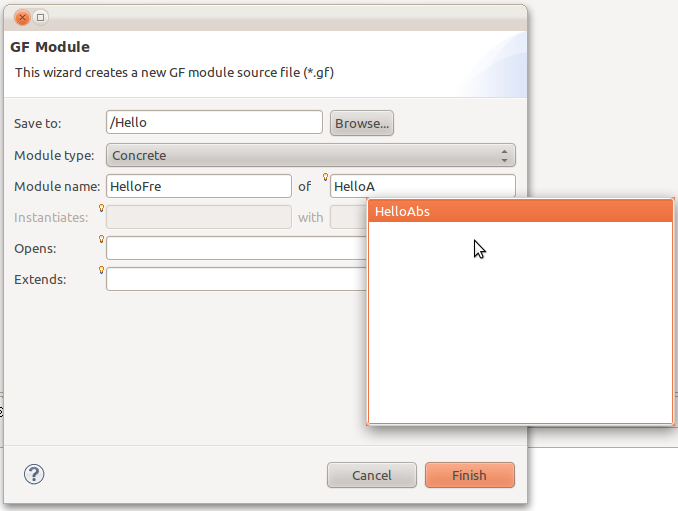
You can find some small examples at http://www.grammaticalframework.org/eclipse/examples/. Download the files and manually add them to your Eclipse workspace to experiment with some of the plugin features.
If you want to clone an existing module into a new language, you can now do so via the Clone GF Module wizard. This is also available as a context menu option in the Project Explorer, via <Richt click> → Grammatical Framework → Compile for new language:
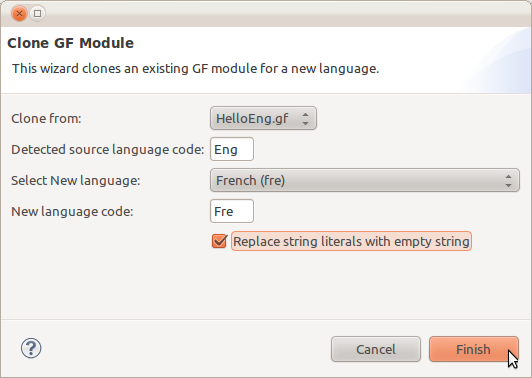
This will create and open a new module with the relevant replacements made. Note how in this case string constants are replaced by the empty string "". This wizard currently only works on concrete and instance modules.
Use Eclipes’ own features to drag and drop your editor tabs to suit your needs.
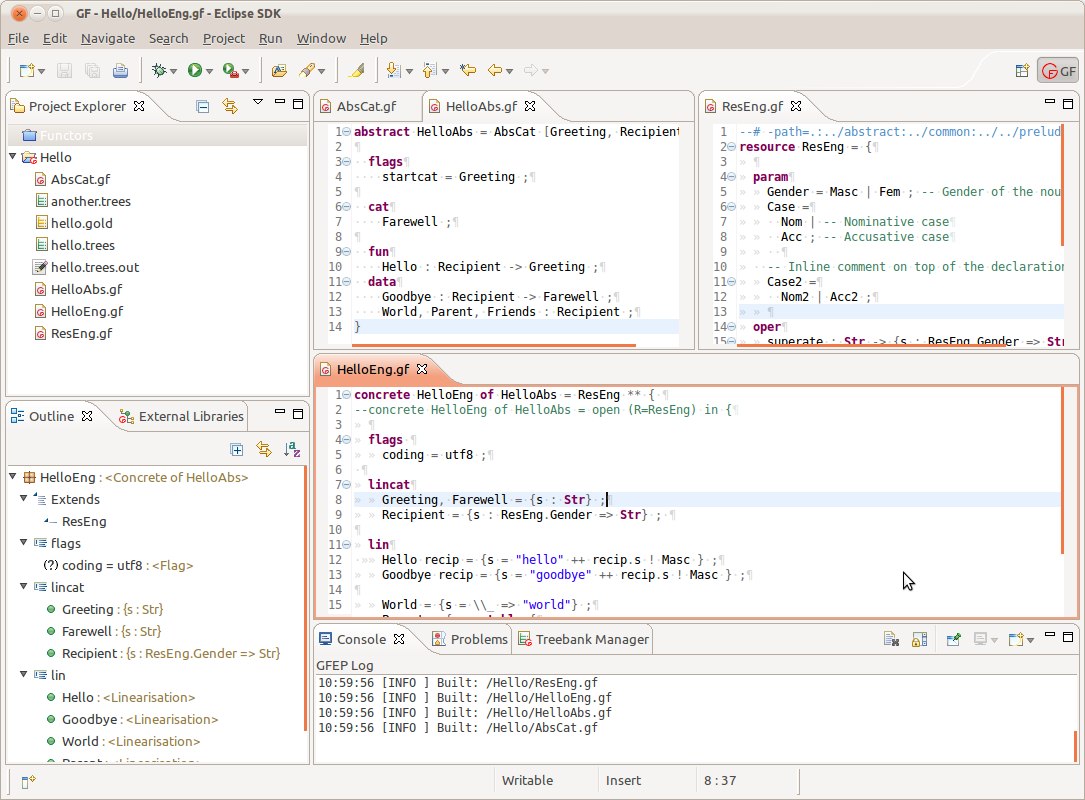
The Outline view in the bottom-right offers a quite overview of your module structure. Clicking any of the terms will make your cursor jump to that point in the file.
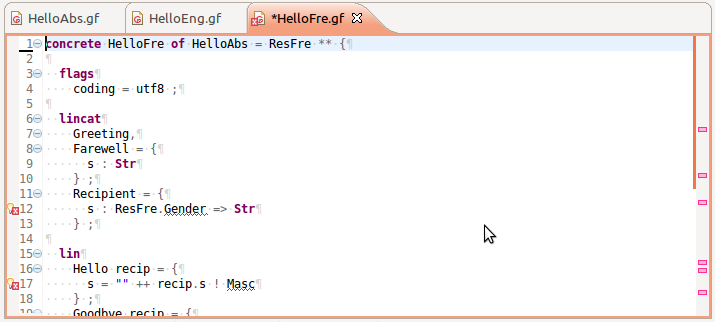
Notice how changing a cat definition for example will produce warnings and/or errors in other the modules.
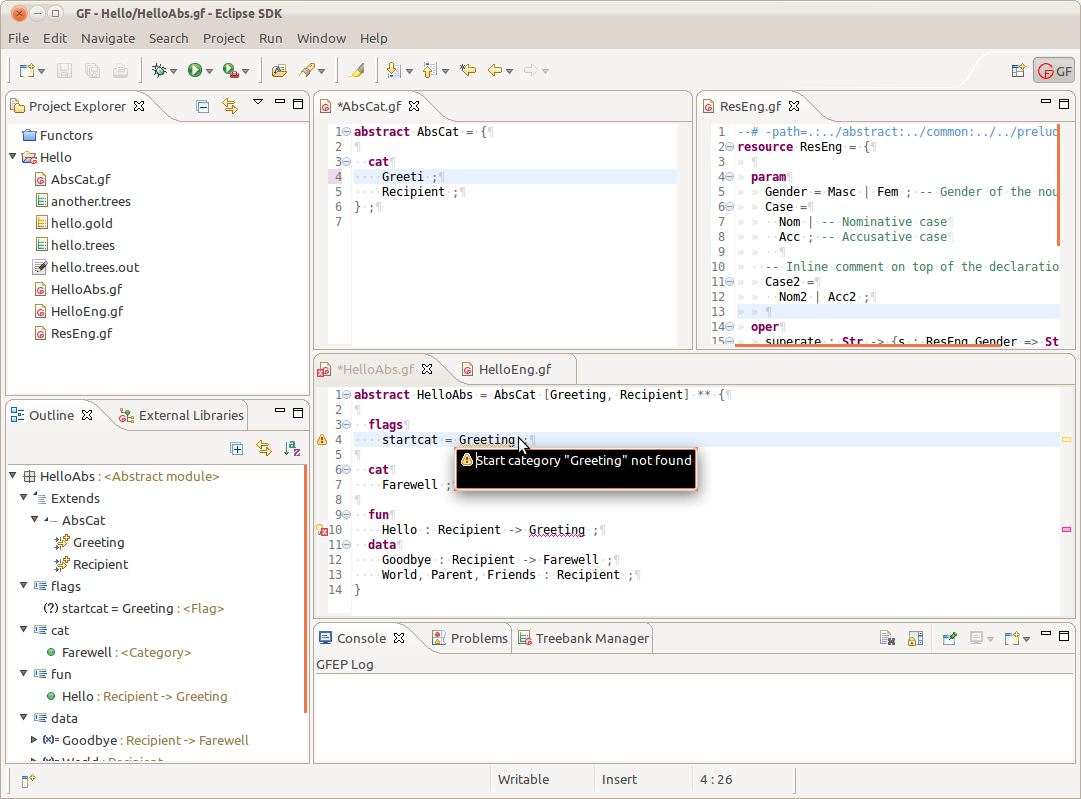
For validation to work correctly, the project’s Build Automatically option should be turned on.
The in-editor validation sometimes needs to be triggered/updated by a keystroke. If you can still see errors which you believe should be correct, try adding a space character to ensure the validation is re-triggered.
Sometimes you may get an entire file marked with errors, even though in fact there is only a single error which is causing the internal builder to fail. In such cases referring to the Problems view should help you locate the cause. This issue is particularly relevant when changes made to one module may induce errors in its descendants (e.g. renaming a parameter in a resource module). This behaviour will hopefully be improved in future versions.
Use the built-in code formatter to tidy your code automatically. Right-click in the editor and choose Format or use the keyboard shortcut Ctrl+Shift+F.
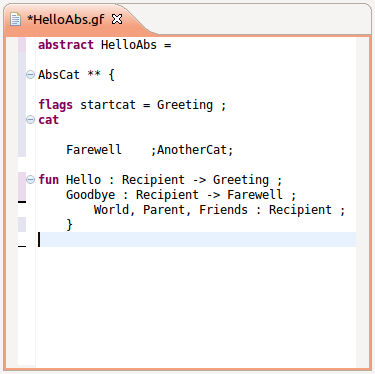

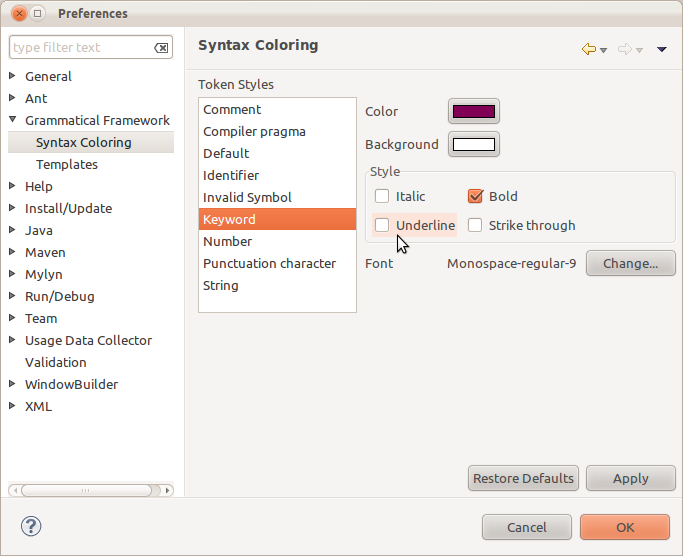
You can change your syntax colouring styles as you wish from Window → Preferences → Grammatical Framework → Syntax Coloring
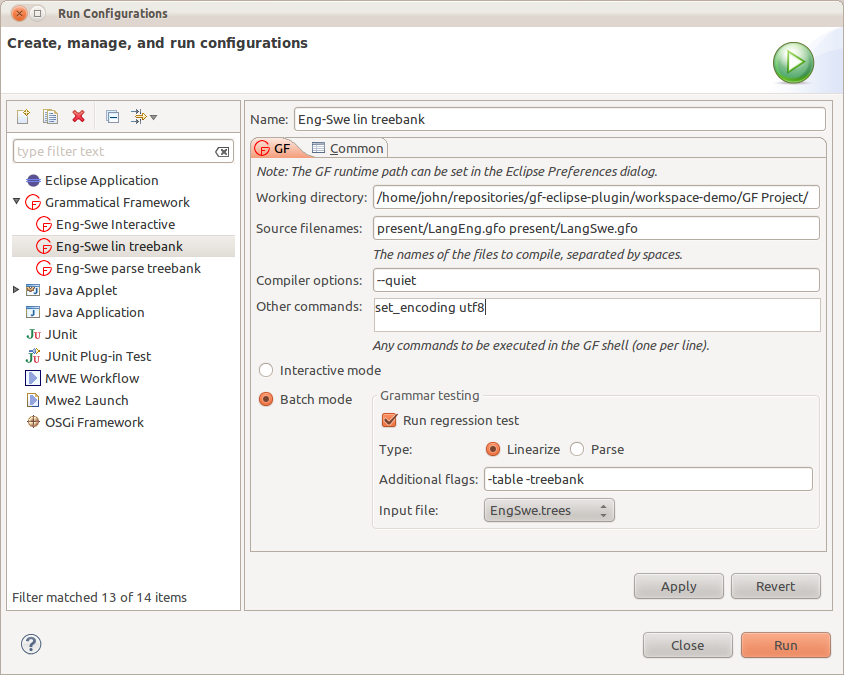
Set up a launch configuration from Run → Run Configurations… → Grammatical Framework. You will see the dialog below with some fields automatically filled in for you.
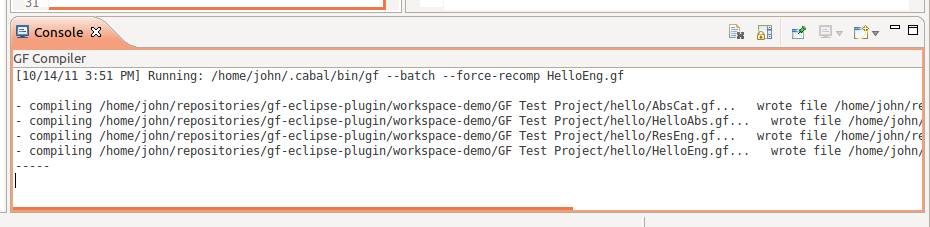
Run the launch config and you will see the output from the GF compiler in the console view within Eclipse.
Using the Run → Run As → Compile with GF shortcut will take the current selection or active editor and do one of two things:
The plugin provides its own console view named GFEP Log, which shows log messages based on the Log Level preference (Window → Preferences → Grammatical Framework).
Additionally, every time a grammar is Run a new console is opened to display the output. This console may also serve as the interactive GF Shell, depending on the Interactive Mode checkbox in your Run Configuration.
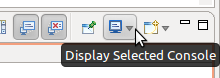
Eclipse does not make it obvious when multiple console windows open; click on the Display Selected Console button to switch between open consoles:
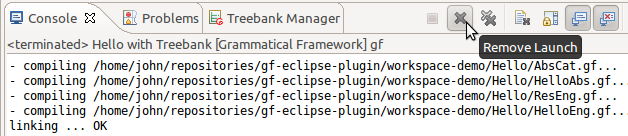
If the process associated with a console window has terminated, it will be indicated in the upper-left corner as below. Such console windows can then be closed using the gray cross button:
The Eclipse console implementation does not support command history (up arrow) or auto-completion (tab).
This view is automatically populated with a list of all the external modules referenced by the current file. Double-clicking on any item provides a quick way of opening GF files which are imported into your grammar from outside your Eclipse project, for example the GF Resource Grammar Library.

Future versions of this view will contain a full tree of all identifiers available in the current scope.
This feature works together with the launch configurations to make the process of testing treebanks against your grammars quick and easy. The general concept (independent of GFEP) is this:
test.trees which contains a bunch of abstract syntax trees, which you want to testrf -lines -tree -file=test.trees | l -table | wf -file=test.trees.outtest.trees.out and save it as your gold standard file test.gold.diff or some other comparison tool.The Treebank Manager view follows this same pattern but provides a convenient graphical interface for running your treebanks and also for looking at the output, just using a few clicks:

The GFEP writes to the Eclipse platform log. This can be accessed in two ways:
<workspace>/.metadata/.logYou can set the log verbosity from Window → Preferences → Grammatical Framework.
Please try to use the plugin for developing your own GF projects and report any issues you come up against.
For all bug reports and feature requests please use the GitHub Issue Tracker at https://github.com/GrammaticalFramework/gf-eclipse-plugin/issues.
Do not hesitate to let us know how you think the plugin can be improved!
As part of the evaluation of the GF Eclipse Plugin, feedback (both negative and positive) on the following would be appreciated: