
The term GF is used for different things:
This tutorial is primarily about the GF program and the GF programming language. It will guide you
The program is open-source free software, which you can download via the
GF Homepage:
http://www.cs.chalmers.se/~aarne/GF
There you can download
If you want to compile GF from source, you need Haskell and Java compilers. But normally you don't have to compile, and you definitely don't need to know Haskell or Java to use GF.
To start the GF program, assuming you have installed it, just type
gf
in the shell. You will see GF's welcome message and the prompt >.
Now you are ready to try out your first grammar.
We start with one that is not written in GF language, but
in the ubiquitous BNF notation (Backus Naur Form), which GF can also
understand. Type (or copy) the following lines in a file named
paleolithic.cf:
    S   ::= NP VP ;
    VP  ::= V | TV NP | "is" A ;
    NP  ::= "this" CN | "that" CN | "the" CN | "a" CN ;
    CN  ::= A CN ;
    CN  ::= "boy" | "louse" | "snake" | "worm" ;
    A   ::= "green" | "rotten" | "thick" | "warm" ;
    V   ::= "laughs" | "sleeps" | "swims" ;
    TV  ::= "eats" | "kills" | "washes" ;
(The name paleolithic refers to a larger package
stoneage,
which implements a fragment of primitive language. This fragment
was defined by the linguist Morris Swadesh as a tool for studying
the historical relations of languages. But as suggested
in the Wiktionary article on
Swadesh list, the
fragment is also usable for basic communication between foreigners.)
The first GF command when using a grammar is to import it.
The command has a long name, import, and a short name, i.
You can type either
import paleolithic.cf
or
i paleolithic.cf
to get the same effect. The effect is that the GF program compiles your grammar into an internal representation, and shows a new prompt when it is ready.
You can now use GF for parsing:
    > parse "the boy eats a snake"
    S_NP_VP (NP_the_CN CN_boy) (VP_TV_NP TV_eats (NP_a_CN CN_snake))

    > parse "the snake eats a boy"
    S_NP_VP (NP_the_CN CN_snake) (VP_TV_NP TV_eats (NP_a_CN CN_boy))
The parse (= p) command takes a string
(in double quotes) and returns an abstract syntax tree - the thing
beginning with S_NP_VP. We will see soon how to make sense
of the abstract syntax trees - now you should just notice that the tree
is different for the two strings.
Strings that return a tree when parsed do so in virtue of the grammar you imported. Try parsing something else, and you fail
    > p "hello world"
    No success in cf parsing hello world
    no tree found
You can also use GF for linearizing
(linearize = l). This is the inverse of
parsing, taking trees into strings:
    > linearize S_NP_VP (NP_the_CN CN_boy) (VP_TV_NP TV_eats (NP_a_CN CN_snake))
    the boy eats a snake
What is the use of this? Typically not that you type in a tree at
the GF prompt. The utility of linearization comes from the fact that
you can obtain a tree from somewhere else. One way to do so is
random generation (generate_random = gr):
    > generate_random
    S_NP_VP (NP_this_CN (CN_A_CN A_thick CN_worm)) (VP_V V_sleeps)
Now you can copy the tree and paste it to the linearize command.
Or, more efficiently, feed random generation into parsing by using
a pipe.
    > gr | l
    this worm is warm
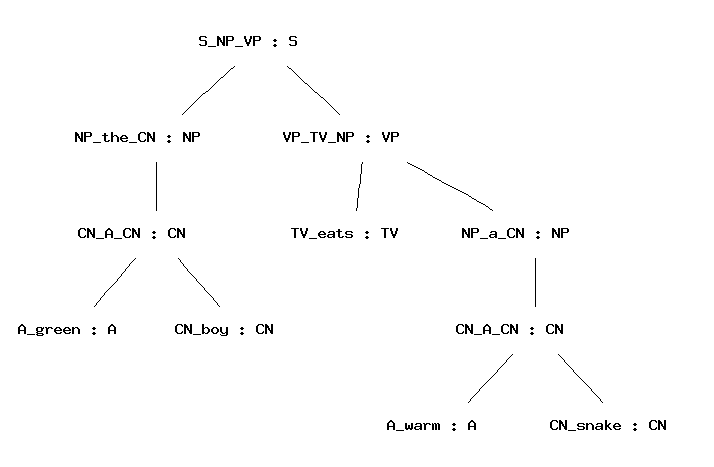
The gibberish code with parentheses returned by the parser does not
look like trees. Why is it called so? Trees are a data structure that
represent <b>nesting</b>: trees are branching entities, and the branches
are themselves trees. Parentheses give a linear representation of trees,
useful for the computer. But the human eye may prefer to see a visualization;
for this purpose, GF provides the command visualizre_tree = vt, to which
parsing (and any other tree-producing command) can be piped:
parse "the green boy eats a warm snake" | vt
Random generation can be quite amusing. So you may want to generate ten strings with one and the same command:
    > gr -number=10 | l
    this boy is green
    a snake laughs
    the rotten boy is thick
    a boy washes this worm
    a boy is warm
    this green warm boy is rotten
    the green thick green louse is rotten
    that boy is green
    this thick thick boy laughs
    a boy is green
To generate all sentence that a grammar
can generate, use the command generate_trees = gt.
    > generate_trees | l
    this louse laughs
    this louse sleeps
    this louse swims
    this louse is green
    this louse is rotten
    ...
    a boy is rotten
    a boy is thick
    a boy is warm
You get quite a few trees but not all of them: only up to a given
depth of trees. To see how you can get more, use the
help = h command,
help gr
Quiz. If the command gt generated all
trees in your grammar, it would never terminate. Why?
A pipe of GF commands can have any length, but the "output type" (either string or tree) of one command must always match the "input type" of the next command.
The intermediate results in a pipe can be observed by putting the
tracing flag -tr to each command whose output you
want to see:
    > gr -tr | l -tr | p

    S_NP_VP (NP_the_CN CN_snake) (VP_V V_sleeps)
    the snake sleeps
    S_NP_VP (NP_the_CN CN_snake) (VP_V V_sleeps)
This facility is good for test purposes: for instance, you may want to see if a grammar is ambiguous, i.e. contains strings that can be parsed in more than one way.
To save the outputs of GF commands into a file, you can
pipe it to the write_file = wf command,
> gr -number=10 | l | write_file exx.tmp
You can read the file back to GF with the
read_file = rf command,
> read_file exx.tmp | p -lines
Notice the flag -lines given to the parsing
command. This flag tells GF to parse each line of
the file separately. Without the flag, the grammar could
not recognize the string in the file, because it is not
a sentence but a sequence of ten sentences.
The syntax trees returned by GF's parser in the previous examples
are not so nice to look at. The identifiers of form Mks
are labels of the BNF rules. To see which label corresponds to
which rule, you can use the print_grammar = pg command
with the printer flag set to cf (which means context-free):
    > print_grammar -printer=cf

    V_laughs. V ::= "laughs" ;
    V_sleeps. V ::= "sleeps" ;
    V_swims. V ::= "swims" ;
    VP_TV_NP. VP ::= TV NP ;
    VP_V. VP ::= V ;
    VP_is_A. VP ::= "is" A ;
    TV_eats. TV ::= "eats" ;
    TV_kills. TV ::= "kills" ;
    TV_washes. TV ::= "washes" ;
    S_NP_VP. S ::= NP VP ;
    NP_a_CN. NP ::= "a" ;
    ...
A syntax tree such as
    NP_this_CN (CN_A_CN A_thick CN_worm)
    this thick worm
encodes the sequence of grammar rules used for building the
expression. If you look at this tree, you will notice that NP_this_CN
is the label of the rule prefixing this to a common noun (CN),
thereby forming a noun phrase (NP).
A_thick is the label of the adjective thick,
and so on. These labels are formed automatically when the grammar
is compiled by GF.
The labelled context-free grammar format permits user-defined
labels to each rule.
In files with the suffix .cf, you can prefix rules with
labels that you provide yourself - these may be more useful
than the automatically generated ones. The following is a possible
labelling of paleolithic.cf with nicer-looking labels.
    PredVP.  S   ::= NP VP ;
    UseV.    VP  ::= V ;
    ComplTV. VP  ::= TV NP ;
    UseA.    VP  ::= "is" A ;
    This.    NP  ::= "this" CN ;
    That.    NP  ::= "that" CN ;
    Def.     NP  ::= "the" CN ;
    Indef.   NP  ::= "a" CN ;
    ModA.    CN  ::= A CN ;
    Boy.     CN  ::= "boy" ;
    Louse.   CN  ::= "louse" ;
    Snake.   CN  ::= "snake" ;
    Worm.    CN  ::= "worm" ;
    Green.   A   ::= "green" ;
    Rotten.  A   ::= "rotten" ;
    Thick.   A   ::= "thick" ;
    Warm.    A   ::= "warm" ;
    Laugh.   V   ::= "laughs" ;
    Sleep.   V   ::= "sleeps" ;
    Swim.    V   ::= "swims" ;
    Eat.     TV  ::= "eats" ;
    Kill.    TV  ::= "kills"
    Wash.    TV  ::= "washes" ;
With this grammar, the trees look as follows:
    > p "the boy eats a snake"
    PredVP (Def Boy) (ComplTV Eat (Indef Snake))

    > gr -tr | l
    PredVP (Indef Louse) (UseA Thick)
    a louse is thick
To see what there is in GF's shell state when a grammar
has been imported, you can give the plain command
print_grammar = pg.
> print_grammar
The output is quite unreadable at this stage, and you may feel happy that you did not need to write the grammar in that notation, but that the GF grammar compiler produced it.
However, we will now start the demonstration
how GF's own notation gives you
much more expressive power than the .cf
format. We will introduce the .gf format by presenting
one more way of defining the same grammar as in
paleolithic.cf.
Then we will show how the full GF grammar format enables you
to do things that are not possible in the weaker formats.
A GF grammar consists of two main parts:
The EBNF and CF formats fuse these two things together, but it is possible to take them apart. For instance, the verb phrase predication rule
PredVP. S ::= NP VP ;
is interpreted as the following pair of rules:
    fun PredVP : NP -> VP -> S ;
    lin PredVP x y = {s = x.s ++ y.s} ;
The former rule, with the keyword fun, belongs to the abstract syntax.
It defines the function
PredVP which constructs syntax trees of form
(PredVP x y).
The latter rule, with the keyword lin, belongs to the concrete syntax.
It defines the linearization function for
syntax trees of form (PredVP x y).
Rules in a GF grammar are called judgements, and the keywords
fun and lin are used for distinguishing between two
judgement forms. Here is a summary of the most important
judgement forms:
| form | reading |
cat C |
C is a category |
fun f : A |
f is a function of type A |
| form | reading |
lincat C = T |
category C has linearization type T |
lin f = t |
function f has linearization t |
We return to the precise meanings of these judgement forms later. First we will look at how judgements are grouped into modules, and show how the paleolithic grammar is expressed by using modules and judgements.
A GF grammar consists of modules, into which judgements are grouped. The most important module forms are
abstract A = M, abstract syntax A with judgements in
the module body M.
concrete C of A = M, concrete syntax C of the
abstract syntax A, with judgements in the module body M.
The linearization type of a category is a record type, with zero of more fields of different types. The simplest record type used for linearization in GF is
{s : Str}
which has one field, with label s and type Str.
Examples of records of this type are
    {s = "foo"}
    {s = "hello" ++ "world"}
The type Str is really the type of token lists, but
most of the time one can conveniently think of it as the type of strings,
denoted by string literals in double quotes.
Whenever a record r of type {s : Str} is given,
r.s is an object of type Str. This is
a special case of the projection rule, allowing the extraction
of fields from a record:
{ ... p : T ... } then r.p : T
To express the abstract syntax of paleolithic.cf in
a file Paleolithic.gf, we write two kinds of judgements:
cat judgement.
fun judgement,
with the type formed from the nonterminals of the rule.
  abstract Paleolithic = {
  cat
    S ; NP ; VP ; CN ; A ; V ; TV ;
  fun
    PredVP  : NP -> VP -> S ;
    UseV    : V -> VP ;
    ComplTV : TV -> NP -> VP ;
    UseA    : A -> VP ;
    ModA    : A -> CN -> CN ;
    This, That, Def, Indef : CN -> NP ;
    Boy, Louse, Snake, Worm : CN ;
    Green, Rotten, Thick, Warm : A ;
    Laugh, Sleep, Swim : V ;
    Eat, Kill, Wash : TV ;
  }
Notice the use of shorthands permitting the sharing of
the keyword in subsequent judgements, and of the type
in subsequent fun judgements.
Each category introduced in Paleolithic.gf is
given a lincat rule, and each
function is given a lin rule. Similar shorthands
apply as in abstract modules.
  concrete PaleolithicEng of Paleolithic = {
  lincat
    S, NP, VP, CN, A, V, TV = {s : Str} ;
  lin
    PredVP np vp  = {s = np.s ++ vp.s} ;
    UseV   v      = v ;
    ComplTV tv np = {s = tv.s ++ np.s} ;
    UseA   a   = {s = "is" ++ a.s} ;
    This  cn   = {s = "this" ++ cn.s} ;
    That  cn   = {s = "that" ++ cn.s} ;
    Def   cn   = {s = "the" ++ cn.s} ;
    Indef cn   = {s = "a" ++ cn.s} ;
    ModA  a cn = {s = a.s ++ cn.s} ;
    Boy    = {s = "boy"} ;
    Louse  = {s = "louse"} ;
    Snake  = {s = "snake"} ;
    Worm   = {s = "worm"} ;
    Green  = {s = "green"} ;
    Rotten = {s = "rotten"} ;
    Thick  = {s = "thick"} ;
    Warm   = {s = "warm"} ;
    Laugh  = {s = "laughs"} ;
    Sleep  = {s = "sleeps"} ;
    Swim   = {s = "swims"} ;
    Eat    = {s = "eats"} ;
    Kill   = {s = "kills"} ;
    Wash   = {s = "washes"} ;
  }
Module name + .gf = file name
Each module is compiled into a .gfc file.
Import PaleolithicEng.gf and try what happens
> i PaleolithicEng.gf
The GF program does not only read the file
PaleolithicEng.gf, but also all other files that it
depends on - in this case, Paleolithic.gf.
For each file that is compiled, a .gfc file
is generated. The GFC format (="GF Canonical") is the
"machine code" of GF, which is faster to process than
GF source files. When reading a module, GF decides whether
to use an existing .gfc file or to generate
a new one, by looking at modification times.
The main advantage of separating abstract from concrete syntax is that one abstract syntax can be equipped with many concrete syntaxes. A system with this property is called a multilingual grammar.
Multilingual grammars can be used for applications such as
translation. Let us buid an Italian concrete syntax for
Paleolithic and then test the resulting
multilingual grammar.
  concrete PaleolithicIta of Paleolithic = {
  lincat
    S, NP, VP, CN, A, V, TV = {s : Str} ;
  lin
    PredVP np vp  = {s = np.s ++ vp.s} ;
    UseV   v      = v ;
    ComplTV tv np = {s = tv.s ++ np.s} ;
    UseA   a   = {s = "è" ++ a.s} ;
    This  cn   = {s = "questo" ++ cn.s} ;
    That  cn   = {s = "quello" ++ cn.s} ;
    Def   cn   = {s = "il" ++ cn.s} ;
    Indef cn   = {s = "un" ++ cn.s} ;
    ModA  a cn = {s = cn.s ++ a.s} ;
    Boy    = {s = "ragazzo"} ;
    Louse  = {s = "pidocchio"} ;
    Snake  = {s = "serpente"} ;
    Worm   = {s = "verme"} ;
    Green  = {s = "verde"} ;
    Rotten = {s = "marcio"} ;
    Thick  = {s = "grosso"} ;
    Warm   = {s = "caldo"} ;
    Laugh  = {s = "ride"} ;
    Sleep  = {s = "dorme"} ;
    Swim   = {s = "nuota"} ;
    Eat    = {s = "mangia"} ;
    Kill   = {s = "uccide"} ;
    Wash   = {s = "lava"} ;
  }
Import the two grammars in the same GF session.
    > i PaleolithicEng.gf
    > i PaleolithicIta.gf
Try generation now:
    > gr | l
    un pidocchio uccide questo ragazzo

    > gr | l -lang=PaleolithicEng
    that louse eats a louse
Translate by using a pipe:
    > p -lang=PaleolithicEng "the boy eats the snake" | l -lang=PaleolithicIta
    il ragazzo mangia il serpente
The lang flag tells GF which concrete syntax to use in parsing and
linearization. By default, the flag is set to the last-imported grammar.
To see what grammars are in scope and which is the main one, use the command
print_options = po:
    > print_options
    main abstract :     Paleolithic
    main concrete :     PaleolithicIta
    actual concretes :  PaleolithicIta PaleolithicEng
This is a simple language exercise that can be automatically
generated from a multilingual grammar. The system generates a set of
random sentences, displays them in one language, and checks the user's
answer given in another language. The command translation_quiz = tq
makes this in a subshell of GF.
    > translation_quiz PaleolithicEng PaleolithicIta

    Welcome to GF Translation Quiz.
    The quiz is over when you have done at least 10 examples
    with at least 75 % success.
    You can interrupt the quiz by entering a line consisting of a dot ('.').

    a green boy washes the louse
    un ragazzo verde lava il gatto

    No, not un ragazzo verde lava il gatto, but
    un ragazzo verde lava il pidocchio
    Score 0/1
You can also generate a list of translation exercises and save it in a
file for later use, by the command translation_list = tl
> translation_list -number=25 PaleolithicEng PaleolithicIta
The number flag gives the number of sentences generated.
The module system of GF makes it possible to extend a grammar in different ways. The syntax of extension is shown by the following example. This is how language was extended when civilization advanced from the paleolithic to the neolithic age:
    abstract Neolithic = Paleolithic ** {
      fun
        Fire, Wheel : CN ;
        Think : V ;
    }
Parallel to the abstract syntax, extensions can be built for concrete syntaxes:
    concrete NeolithicEng of Neolithic = PaleolithicEng ** {
      lin
        Fire  = {s = "fire"} ;
        Wheel = {s = "wheel"} ;
        Think = {s = "thinks"} ;
    }
The effect of extension is that all of the contents of the extended and extending module are put together.
Specialized vocabularies can be represented as small grammars that only do "one thing" each. For instance, the following are grammars for fish names and mushroom names.
    abstract Fish = {
      cat Fish ;
      fun Salmon, Perch : Fish ;
    }

    abstract Mushrooms = {
      cat Mushroom ;
      fun Cep, Agaric : Mushroom ;
    }
They can afterwards be combined into bigger grammars by using multiple inheritance, i.e. extension of several grammars at the same time:
    abstract Gatherer = Paleolithic, Fish, Mushrooms ** {
      fun
        FishCN     : Fish     -> CN ;
        MushroomCN : Mushroom -> CN ;
      }
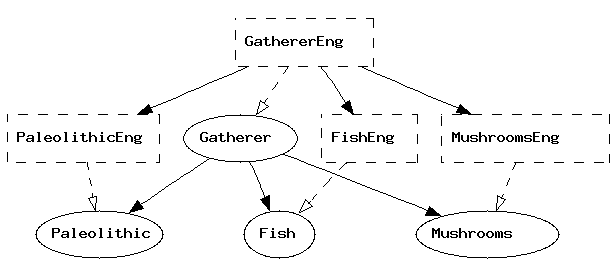
When you have created all the abstract syntaxes and
one set of concrete syntaxes needed for Gatherer,
your grammar consists of eight GF modules. To see how their
dependences look like, you can use the command
visualize_graph = vg,
> visualize_graph
and the graph will pop up in a separate window.
The graph uses
To document your grammar, you may want to print the
graph into a file, e.g. a .gif file that
can be included in an HTML document. You can do this
by first printing the graph into a file .dot and then
processing this file with the dot program.
    > pm -printer=graph | wf Gatherer.dot
    > ! dot -Tgif Gatherer.dot > Gatherer.gif
The latter command is a Unix command, issued from GF by using the
shell escape symbol !. The resulting graph is shown in the next section.
The command print_multi = pm is used for printing the current multilingual
grammar in various formats, of which the format -printer=graph just
shows the module dependencies. Use the help to see what other formats
are available:
    > help pm
    > help -printer
In comparison to the .cf format, the .gf format still looks rather
verbose, and demands lots more characters to be written. You have probably
done this by the copy-paste-modify method, which is a standard way to
avoid repeating work.
However, there is a more elegant way to avoid repeating work than the copy-and-paste method. The golden rule of functional programming says that
A function separates the shared parts of different computations from the changing parts, parameters. In functional programming languages, such as Haskell, it is possible to share muc more than in the languages such as C and Java.
GF is a functional programming language, not only in the sense that
the abstract syntax is a system of functions (fun), but also because
functional programming can be used to define concrete syntax. This is
done by using a new form of judgement, with the keyword oper (for
operation), distinct from fun for the sake of clarity.
Here is a simple example of an operation:
oper ss : Str -> {s : Str} = \x -> {s = x} ;
The operation can be applied to an argument, and GF will compute the application into a value. For instance,
ss "boy" ---> {s = "boy"}
(We use the symbol ---> to indicate how an expression is
computed into a value; this symbol is not a part of GF)
Thus an oper judgement includes the name of the defined operation,
its type, and an expression defining it. As for the syntax of the defining
expression, notice the lambda abstraction form \x -> t of
the function.
Operator definitions can be included in a concrete syntax. But they are not really tied to a particular set of linearization rules. They should rather be seen as resources usable in many concrete syntaxes.
The resource module type can be used to package
oper definitions into reusable resources. Here is
an example, with a handful of operations to manipulate
strings and records.
    resource StringOper = {
      oper
        SS : Type = {s : Str} ;

        ss : Str -> SS = \x -> {s = x} ;

        cc : SS -> SS -> SS = \x,y -> ss (x.s ++ y.s) ;

        prefix : Str -> SS -> SS = \p,x -> ss (p ++ x.s) ;
    }
Resource modules can extend other resource modules, in the same way as modules of other types can extend modules of the same type. Thus it is possible to build resource hierarchies.
Any number of resource modules can be
opened in a concrete syntax, which
makes definitions contained
in the resource usable in the concrete syntax. Here is
an example, where the resource StringOper is
opened in a new version of PaleolithicEng.
  concrete PalEng of Paleolithic = open StringOper in {
    lincat
      S, NP, VP, CN, A, V, TV = SS ;
    lin
      PredVP  = cc ;
      UseV v  = v ;
      ComplTV = cc ;
      UseA  = prefix "is" ;
      This  = prefix "this" ;
      That  = prefix "that" ;
      Def   = prefix "the" ;
      Indef = prefix "a" ;
      ModA  = cc ;
      Boy    = ss "boy" ;
      Louse  = ss "louse" ;
      Snake  = ss "snake" ;
      -- etc
  }
The same string operations could be use to write PaleolithicIta
more concisely.
Using operations defined in resource modules is a way to avoid repetitive code. In addition, it enables a new kind of modularity and division of labour in grammar writing: grammarians familiar with the linguistic details of a language can put this knowledge available through resource grammar modules, whose users only need to pick the right operations and not to know their implementation details.
Suppose we want to say, with the vocabulary included in
Paleolithic.gf, things like
    the boy eats two snakes
    all boys sleep
The new grammatical facility we need are the plural forms of nouns and verbs (boys, sleep), as opposed to their singular forms.
The introduction of plural forms requires two things:
Different languages have different rules of inflection and agreement. For instance, Italian has also agreement in gender (masculine vs. feminine). We want to express such special features of languages in the concrete syntax while ignoring them in the abstract syntax.
To be able to do all this, we need one new judgement form, many new expression forms, and a generalizarion of linearization types from strings to more complex types.
We define the parameter type of number in Englisn by using a new form of judgement:
param Number = Sg | Pl ;
To express that nouns in English have a linearization
depending on number, we replace the linearization type {s : Str}
with a type where the s field is a table depending on number:
lincat CN = {s : Number => Str} ;
The table type Number => Str is in many respects similar to
a function type (Number -> Str). The main difference is that the
argument type of a table type must always be a parameter type. This means
that the argument-value pairs can be listed in a finite table. The following
example shows such a table:
    lin Boy = {s = table {
      Sg => "boy" ;
      Pl => "boys"
      }
    } ;
The application of a table to a parameter is done by the selection
operator !. For instance,
Boy.s ! Pl
is a selection, whose value is "boys".
All English common nouns are inflected in number, most of them in the same way: the plural form is formed from the singular form by adding the ending s. This rule is an example of a paradigm - a formula telling how the inflection forms of a word are formed.
From GF point of view, a paradigm is a function that takes a lemma -
a string also known as a dictionary form - and returns an inflection
table of desired type. Paradigms are not functions in the sense of the
fun judgements of abstract syntax (which operate on trees and not
on strings), but operations defined in oper judgements.
The following operation defines the regular noun paradigm of English:
    oper regNoun : Str -> {s : Number => Str} = \x -> {
      s = table {
        Sg => x ;
        Pl => x + "s"
        }
      } ;
The glueing operator + tells that
the string held in the variable x and the ending "s"
are written together to form one token. Thus, for instance,
(regNoun "boy").s ! Pl ---> "boy" + "s" ---> "boys"
Some English nouns, such as louse, are so irregular that
it makes no sense to see them as instances of a paradigm. Even
then, it is useful to perform data abstraction from the
definition of the type Noun, and introduce a constructor
operation, a worst-case macro for nouns:
    oper mkNoun : Str -> Str -> Noun = \x,y -> {
      s = table {
        Sg => x ;
        Pl => y
        }
      } ;
Thus we define
lin Louse = mkNoun "louse" "lice" ;
and
    oper regNoun : Str -> Noun = \x ->
      mkNoun x (x + "s") ;
instead of writing the inflection table explicitly.
The grammar engineering advantage of worst-case macros is that
the author of the resource module may change the definitions of
Noun and mkNoun, and still retain the
interface (i.e. the system of type signatures) that makes it
correct to use these functions in concrete modules. In programming
terms, Noun is then treated as an abstract datatype.
In addition to the completely regular noun paradigm regNoun,
some other frequent noun paradigms deserve to be
defined, for instance,
sNoun : Str -> Noun = \kiss -> mkNoun kiss (kiss + "es") ;
What about nouns like fly, with the plural flies? The already available solution is to use the longest common prefix fl (also known as the technical stem) as argument, and define
yNoun : Str -> Noun = \fl -> mkNoun (fl + "y") (fl + "ies") ;
But this paradigm would be very unintuitive to use, because the technical stem
is not an existing form of the word. A better solution is to use
the lemma and a string operator init, which returns the initial segment (i.e.
all characters but the last) of a string:
yNoun : Str -> Noun = \fly -> mkNoun fly (init fly + "ies") ;
The operator init belongs to a set of operations in the
resource module Prelude, which therefore has to be
opened so that init can be used.
It may be hard for the user of a resource morphology to pick the right
inflection paradigm. A way to help this is to define a more intelligent
paradigm, which chooses the ending by first analysing the lemma.
The following variant for English regular nouns puts together all the
previously shown paradigms, and chooses one of them on the basis of
the final letter of the lemma (found by the prelude operator last).
    regNoun : Str -> Noun = \s -> case last s of {
      "s" | "z" => mkNoun s (s + "es") ;
      "y"       => mkNoun s (init s + "ies") ;
      _         => mkNoun s (s + "s")
      } ;
This definition displays many GF expression forms not shown befores; these forms are explained in the next section.
The paradigms regNoun does not give the correct forms for
all nouns. For instance, louse - lice and
fish - fish must be given by using mkNoun.
Also the word boy would be inflected incorrectly; to prevent
this, either use mkNoun or modify
regNoun so that the "y" case does not
apply if the second-last character is a vowel.
Expressions of the table form are built from lists of
argument-value pairs. These pairs are called the branches
of the table. In addition to constants introduced in
param definitions, the left-hand side of a branch can more
generally be a pattern, and the computation of selection is
then performed by pattern matching:
_ matches anything
"s", matches the same string
P | ... | Q matches anything that
one of the disjuncts matches
Pattern matching is performed in the order in which the branches appear in the table: the branch of the first matching pattern is followed.
As syntactic sugar, one-branch tables can be written concisely,
\\P,...,Q => t === table {P => ... table {Q => t} ...}
Finally, the case expressions common in functional
programming languages are syntactic sugar for table selections:
case e of {...} === table {...} ! e
A common idiom is to
gather the oper and param definitions
needed for inflecting words in
a language into a morphology module. Here is a simple
example, MorphoEng.
    --# -path=.:prelude

    resource MorphoEng = open Prelude in {

      param
        Number = Sg | Pl ;

      oper
        Noun, Verb : Type = {s : Number => Str} ;

        mkNoun : Str -> Str -> Noun = \x,y -> {
          s = table {
            Sg => x ;
            Pl => y
            }
          } ;

        regNoun : Str -> Noun = \s -> case last s of {
          "s" | "z" => mkNoun s (s + "es") ;
          "y"       => mkNoun s (init s + "ies") ;
          _         => mkNoun s (s + "s")
          } ;

        mkVerb : Str -> Str -> Verb = \x,y -> mkNoun y x ;

        regVerb : Str -> Verb = \s -> case last s of {
          "s" | "z" => mkVerb s (s + "es") ;
          "y"       => mkVerb s (init s + "ies") ;
          "o"       => mkVerb s (s + "es") ;
          _         => mkVerb s (s + "s")
          } ;
    }
The first line gives as a hint to the compiler the
search path needed to find all the other modules that the
module depends on. The directory prelude is a subdirectory of
GF/lib; to be able to refer to it in this simple way, you can
set the environment variable GF_LIB_PATH to point to this
directory.
To test a resource module independently, you can import it
with a flag that tells GF to retain the oper definitions
in the memory; the usual behaviour is that oper definitions
are just applied to compile linearization rules
(this is called inlining) and then thrown away.
> i -retain MorphoEng.gf
The command compute_concrete = cc computes any expression
formed by operations and other GF constructs. For example,
    > cc regVerb "echo"
    {s : Number => Str = table Number {
      Sg => "echoes" ;
      Pl => "echo"
      }
    }
The command show_operations = so` shows the type signatures
of all operations returning a given value type:
    > so Verb
    MorphoEng.mkNoun : Str -> Str -> {s : {MorphoEng.Number} => Str}
    MorphoEng.mkVerb : Str -> Str -> {s : {MorphoEng.Number} => Str}
    MorphoEng.regNoun : Str -> {s : {MorphoEng.Number} => Str}
    MorphoEng.regVerb : Str -> { s : {MorphoEng.Number} => Str}
Why does the command also show the operations that form
Nouns? The reason is that the type expression
Verb is first computed, and its value happens to be
the same as the value of Noun.
We can now enrich the concrete syntax definitions to comprise morphology. This will involve a more radical variation between languages (e.g. English and Italian) then just the use of different words. In general, parameters and linearization types are different in different languages - but this does not prevent the use of a common abstract syntax.
The rule of subject-verb agreement in English says that the verb phrase must be inflected in the number of the subject. This means that a noun phrase (functioning as a subject), inherently has a number, which it passes to the verb. The verb does not have a number, but must be able to receive whatever number the subject has. This distinction is nicely represented by the different linearization types of noun phrases and verb phrases:
    lincat NP = {s : Str ; n : Number} ;
    lincat VP = {s : Number => Str} ;
We say that the number of NP is an inherent feature,
whereas the number of NP is parametric.
The agreement rule itself is expressed in the linearization rule of the predication structure:
lin PredVP np vp = {s = np.s ++ vp.s ! np.n} ;
The following section will present a new version of
PaleolithingEng, assuming an abstract syntax
xextended with All and Two.
It also assumes that MorphoEng has a paradigm
regVerb for regular verbs (which need only be
regular only in the present tensse).
The reader is invited to inspect the way in which agreement works in
the formation of noun phrases and verb phrases.
  concrete PaleolithicEng of Paleolithic = open MorphoEng in {
  lincat
    S, A          = {s : Str} ;
    VP, CN, V, TV = {s : Number => Str} ;
    NP            = {s : Str ; n : Number} ;
  lin
    PredVP np vp  = {s = np.s ++ vp.s ! np.n} ;
    UseV   v      = v ;
    ComplTV tv np = {s = \\n => tv.s ! n ++ np.s} ;
    UseA   a   = {s = \\n => case n of {Sg => "is" ; Pl => "are"} ++ a.s} ;
    This  cn   = {s = "this" ++ cn.s ! Sg } ;
    Indef cn   = {s = "a" ++ cn.s ! Sg} ;
    All   cn   = {s = "all" ++ cn.s ! Pl} ;
    Two   cn   = {s = "two" ++ cn.s ! Pl} ;
    ModA  a cn = {s = \\n => a.s ++ cn.s ! n} ;
    Louse  = mkNoun "louse" "lice" ;
    Snake  = regNoun "snake" ;
    Green  = {s = "green"} ;
    Warm   = {s = "warm"} ;
    Laugh  = regVerb "laugh" ;
    Sleep  = regVerb "sleep" ;
    Kill   = regVerb "kill" ;
  }
The reader familiar with a functional programming language such as
<a href="http://www.haskell.org">Haskell<a> must have noticed the similarity
between parameter types in GF and algebraic datatypes (data definitions
in Haskell). The GF parameter types are actually a special case of algebraic
datatypes: the main restriction is that in GF, these types must be finite.
(This restriction makes it possible to invert linearization rules into
parsing methods.)
However, finite is not the same thing as enumerated. Even in GF, parameter constructors can take arguments, provided these arguments are from other parameter types (recursion is forbidden). Such parameter types impose a hierarchic order among parameters. They are often useful to define linguistically accurate parameter systems.
To give an example, Swedish adjectives
are inflected in number (singular or plural) and
gender (uter or neuter). These parameters would suggest 2*2=4 different
forms. However, the gender distinction is done only in the singular. Therefore,
it would be inaccurate to define adjective paradigms using the type
Gender => Number => Str. The following hierarchic definition
yields an accurate system of three adjectival forms.
    param AdjForm = ASg Gender | APl ;
    param Gender  = Uter | Neuter ;
In pattern matching, a constructor can have patterns as arguments. For instance, the adjectival paradigm in which the two singular forms are the same, can be defined
    oper plattAdj : Str -> AdjForm => Str = \x -> table {
      ASg _ => x ;
      APl   => x + "a" ;
      }
Even though in GF morphology
is mostly seen as an auxiliary of syntax, a morphology once defined
can be used on its own right. The command morpho_analyse = ma
can be used to read a text and return for each word the analyses that
it has in the current concrete syntax.
> rf bible.txt | morpho_analyse
In the same way as translation exercises, morphological exercises can
be generated, by the command morpho_quiz = mq. Usually,
the category is set to be something else than S. For instance,
    > i lib/resource/french/VerbsFre.gf
    > morpho_quiz -cat=V

    Welcome to GF Morphology Quiz.
    ...

    réapparaître : VFin VCondit  Pl  P2
    réapparaitriez
    > No, not réapparaitriez, but
    réapparaîtriez
    Score 0/1
Finally, a list of morphological exercises and save it in a
file for later use, by the command morpho_list = ml
> morpho_list -number=25 -cat=V
The number flag gives the number of exercises generated.
A linearization type may contain more strings than one. An example of where this is useful are English particle verbs, such as switch off. The linearization of a sentence may place the object between the verb and the particle: he switched it off.
The first of the following judgements defines transitive verbs as a discontinuous constituents, i.e. as having a linearization type with two strings and not just one. The second judgement shows how the constituents are separated by the object in complementization.
    lincat TV = {s : Number => Str ; s2 : Str} ;
    lin ComplTV tv obj = {s = \\n => tv.s ! n ++ obj.s ++ tv.s2} ;
GF currently requires that all fields in linearization records that
have a table with value type Str have as labels
either s or s with an integer index.