mirror of
https://github.com/GrammaticalFramework/gf-core.git
synced 2026-04-30 14:52:51 -06:00

564 lines
19 KiB
Markdown
564 lines
19 KiB
Markdown
# gftest: Automatic systematic test case generation for GF grammars
|
|
|
|
`gftest` is a program for automatically generating systematic test
|
|
cases for GF grammars. The basic use case is to give `gftest` a
|
|
PGF grammar, a concrete language and a function; then `gftest` generates a
|
|
representative and minimal set of example sentences for a human to look at.
|
|
|
|
There are examples of actual generated test cases later in this
|
|
document, as well as the full list of options to give to `gftest`.
|
|
|
|
## Table of Contents
|
|
|
|
- [Installation](#installation)
|
|
- [Prerequisites](#prerequisites)
|
|
- [Install gftest](#install-gftest)
|
|
- [Common use cases](#common-use-cases)
|
|
- [Grammar: `-g`](#grammar--g)
|
|
- [Language: `-l`](#language--l)
|
|
- [Function(s) to test: `-f`](#functions-to-test--f)
|
|
- [Start category for context: `-s`](#start-category-for-context--s)
|
|
- [Category to test: `-c`](#category-to-test--c)
|
|
- [Tree to test: `-t`](#tree-to-test--t)
|
|
- [Compare against an old version of the grammar: `-o`](#compare-against-an-old-version-of-the-grammar--o)
|
|
- [Information about a particular string: `--concr-string`](#information-about-a-particular-string---concr-string)
|
|
- [Write into a file: `-w`](#write-into-a-file--w)
|
|
- [Less common use cases](#less-common-use-cases)
|
|
- [Empty or always identical fields: `-e`, `-q`](#empty-or-always-identical-fields--e--q)
|
|
- [Unused fields: `-u`](#unused-fields--u)
|
|
- [Erased trees: `-r`](#erased-trees--r)
|
|
- [Debug information: `-d`](#debug-intormation--d)
|
|
- [Detailed information about the grammar](#detailed-information-about-the-grammar)
|
|
- [--show-cats](#--show-cats)
|
|
- [--show-funs](#--show-funs)
|
|
- [--show-coercions](#--show-coercions)
|
|
- [--show-contexts](#--show-contexts)
|
|
- [--count-trees](#--count-trees)
|
|
- [--funs-of-arity](#--funs-of-arity)
|
|
|
|
## Installation
|
|
|
|
### Prerequisites
|
|
|
|
You need the library `PGF2`. Here are instructions how to install:
|
|
|
|
1) Install C runtime: go to the directory [GF/src/runtime/c](https://github.com/GrammaticalFramework/GF/tree/master/src/runtime/c), see
|
|
instructions in INSTALL
|
|
1) Install PGF2 in one of the two ways:
|
|
* **EITHER** Go to the directory
|
|
[GF/src/runtime/haskell-bind](https://github.com/GrammaticalFramework/GF/tree/master/src/runtime/haskell-bind),
|
|
do `cabal install`
|
|
* **OR** Go to the root directory of
|
|
[GF](https://github.com/GrammaticalFramework/GF/) and compile GF
|
|
with C-runtime system support: `cabal
|
|
install -fc-runtime`, see more information [here](http://www.grammaticalframework.org/doc/gf-developers.html#toc16).
|
|
|
|
### Install gftest
|
|
|
|
Go to
|
|
[GF/src/tools](https://github.com/GrammaticalFramework/GF/tree/master/src/tools),
|
|
do `cabal install`. It creates an executable `gftest`.
|
|
|
|
|
|
## Common use cases
|
|
|
|
Run `gftest --help` of `gftest -?` to get the list of options.
|
|
|
|
```
|
|
Common flags:
|
|
-g --grammar=FILE Path to the grammar (PGF) you want to test
|
|
-l --lang="Eng Swe" Concrete syntax + optional translations
|
|
-f --function=UseN Test the given function(s)
|
|
-c --category=NP Test all functions with given goal category
|
|
-t --tree="UseN tree_N" Test the given tree
|
|
-s --start-cat=Utt Use the given category as start category
|
|
--show-cats Show all available categories
|
|
--show-funs Show all available functions
|
|
--funs-of-arity=2 Show all functions of arity 2
|
|
--show-coercions Show coercions in the grammar
|
|
--show-contexts=8410 Show contexts for a given concrete type (given as FId)
|
|
--concr-string=the Show all functions that include given string
|
|
-q --equal-fields Show fields whose strings are always identical
|
|
-e --empty-fields Show fields whose strings are always empty
|
|
-u --unused-fields Show fields that never make it into the top category
|
|
-r --erased-trees Show trees that are erased
|
|
-o --old-grammar=ITEM Path to an earlier version of the grammar
|
|
--only-changed-cats When comparing against an earlier version of a
|
|
grammar, only test functions in categories that have
|
|
changed between versions
|
|
-b --treebank=ITEM Path to a treebank
|
|
--count-trees=3 Number of trees of depth <depth>
|
|
-d --debug Show debug output
|
|
-w --write-to-file Write the results in a file (<GRAMMAR>_<FUN>.org)
|
|
-? --help Display help message
|
|
-V --version Print version information
|
|
```
|
|
|
|
### Grammar: `-g`
|
|
|
|
Give the PGF grammar as an argument with `-g`. If the file is not in
|
|
the same directory, you need to give the full file path.
|
|
|
|
You can give the grammar with or without `.pgf`.
|
|
|
|
Without a concrete syntax you can't do much, but you can see the
|
|
available categories and functions with `--show-cats` and `--show-funs`
|
|
|
|
Examples:
|
|
|
|
* `gftest -g Foods --show-funs`
|
|
* `gftest -g /home/inari/grammars/LangEng.pgf --show-cats`
|
|
|
|
|
|
### Language: `-l`
|
|
|
|
Give a concrete language. It assumes the format `AbsNameConcName`, and you should only give the `ConcName` part.
|
|
|
|
You can give multiple languages, in which case it will create the test cases based on the first, and show translations in the rest.
|
|
|
|
Examples:
|
|
|
|
* `gftest -g Phrasebook -l Swe --show-cats`
|
|
* `gftest -g Foods -l "Spa Eng" -f Pizza`
|
|
|
|
### Function(s) to test: `-f`
|
|
|
|
Given a grammar (`-g`) and a concrete language ( `-l`), test a function or several functions.
|
|
|
|
Examples:
|
|
|
|
* `gftest -g Lang -l "Dut Eng" -f UseN`
|
|
* `gftest -g Phrasebook -l Spa -f "ByTransp ByFoot"`
|
|
|
|
You can use the wildcard `*`, if you want to match multiple functions. Examples:
|
|
|
|
* `gftest -g Lang -l Eng -f "*hat*"`
|
|
|
|
matches `hat_N, hate_V2, that_Quant, that_Subj, whatPl_IP` and `whatSg_IP`.
|
|
|
|
* `gftest -g Lang -l Eng -f "*hat*u*"`
|
|
|
|
matches `that_Quant` and `that_Subj`.
|
|
|
|
* `gftest -g Lang -l Eng -f "*"`
|
|
|
|
matches all functions in the grammar. (As of March 2018, takes 13
|
|
minutes for the English resource grammar, and results in ~40k
|
|
lines. You may not want to do this for big grammars.)
|
|
|
|
### Start category for context: `-s`
|
|
|
|
Give a start category for contexts. Used in conjunction with `-f`,
|
|
`-c`, `-t` or `--count-trees`. If not specified, contexts are created
|
|
for the start category of the grammar.
|
|
|
|
Example:
|
|
|
|
* `gftest -g Lang -l "Dut Eng" -f UseN -s Adv`
|
|
|
|
This creates a hole of `CN` in `Adv`, instead of the default start category.
|
|
|
|
### Category to test: `-c`
|
|
|
|
Given a grammar (`-g`) and a concrete language ( `-l`), test all functions that return a given category.
|
|
|
|
Examples:
|
|
|
|
* `gftest -g Phrasebook -l Fre -c Modality`
|
|
* `gftest -g Phrasebook -l Fre -c ByTransport -s Action`
|
|
|
|
|
|
### Tree to test: `-t`
|
|
|
|
Given a grammar (`-g`) and a concrete language ( `-l`), test a complete tree.
|
|
|
|
Example:
|
|
|
|
* `gftest -g Phrasebook -l Dut -t "ByTransp Bus"`
|
|
|
|
You can combine it with any of the other flags, e.g. put it in a
|
|
different start category:
|
|
|
|
* `gftest -g Phrasebook -l Dut -t "ByTransp Bus" -s Action`
|
|
|
|
|
|
This may be useful for the following case. Say you tested `PrepNP`,
|
|
and the default NP it gave you only uses the word *car*, but you
|
|
would really want to see it for some other noun—maybe `car_N` itself
|
|
is buggy, and you want to be sure that `PrepNP` works properly. So
|
|
then you can call the following:
|
|
|
|
* `gftest -g TestLang -l Eng -t "PrepNP with_Prep (MassNP (UseN beer_N))"`
|
|
|
|
### Compare against an old version of the grammar: `-o`
|
|
|
|
Give a grammar, a concrete syntax, and an old version of the same
|
|
grammar as a separate PGF file. The program generates test sentences
|
|
for all functions (if no other arguments), linearises with both
|
|
grammars, and outputs those that differ between the versions. It
|
|
writes the differences into files.
|
|
|
|
Example:
|
|
|
|
```
|
|
> gftest -g TestLang -l Eng -o TestLangOld
|
|
Created file TestLangEng-ccat-diff.org
|
|
Testing functions in…
|
|
<categories flashing by>
|
|
Created file TestLangEng-lin-diff.org
|
|
Created files TestLangEng-(old|new)-funs.org
|
|
```
|
|
|
|
* TestLangEng-ccat-diff.org: All concrete categories that have
|
|
changed. Shows e.g. if you added or removed a parameter or a
|
|
field.
|
|
|
|
* **TestLangEng-lin-diff.org** (usually the most relevant file): All
|
|
trees that have different linearisations in the following format.
|
|
|
|
```
|
|
* send_V3
|
|
|
|
** UseCl (TTAnt TPres ASimul) PPos (PredVP (UsePron we_Pron) (ReflVP (Slash3V3 ∅ (UsePron it_Pron))))
|
|
TestLangDut> we sturen onszelf ernaar
|
|
TestLangDut-OLD> we sturen zichzelf ernaar
|
|
|
|
|
|
** UseCl (TTAnt TPast ASimul) PPos (PredVP (UsePron we_Pron) (ReflVP (Slash3V3 ∅ (UsePron it_Pron))))
|
|
TestLangDut> we stuurden onszelf ernaar
|
|
TestLangDut-OLD> we stuurden zichzelf ernaar
|
|
```
|
|
|
|
* TestLangEng-old-funs.org and TestLangEng-new-funs.org: groups the
|
|
functions by their concrete categories. Shows difference if you have
|
|
e.g. added or removed parameters, and that has created new versions of
|
|
some functions: say you didn't have gender in nouns, but now you
|
|
have, then all functions taking nouns have suddenly a gendered
|
|
version. (This is kind of hard to read, don't worry too much if the
|
|
output doesn't make any sense.)
|
|
|
|
#### Additional arguments to `-o`
|
|
|
|
The default mode is to test all functions, but you can also give any
|
|
combination of `-s`, `-f`, `-c`, `--treebank`/`-b` and `--only-changed-cats`.
|
|
|
|
With `-s`, you can change the start category in which contexts are
|
|
generated.
|
|
|
|
With `-f` and `-c`, it tests only the specified functions and
|
|
categories.
|
|
With `-b FILEPATH` (`-b`=`--treebank`), it tests only the trees in the file.
|
|
|
|
With `--only-changed-cats`, it only test functions in those categories
|
|
that have changed between the two versions.
|
|
|
|
Examples:
|
|
|
|
* `gftest -g TestLang -l Eng -o TestLangOld` tests all functions
|
|
* `gftest -g TestLang -l Eng -o TestLangOld -s S` tests all functions in start category S
|
|
* `gftest -g TestLang -l Eng -o TestLangOld --only-changed-cats` tests only changed categories. If no categories have changed (and no other arguments specified), tests everything.
|
|
* `gftest -g TestLang -l Eng -o TestLangOld -f "AdjCN AdvCN" -c Adv -b trees.txt` tests functions, `AdjCN` and `AdvCN`; same for all functions that produce an `Adv`, and all trees in trees.txt.
|
|
|
|
### Information about a particular string: `--concr-string`
|
|
|
|
Show all functions that introduce the string given as an argument.
|
|
|
|
Example:
|
|
|
|
* `gftest -g Lang -l Eng --concr-string it`
|
|
|
|
which gives the answer `==> CleftAdv, CleftNP, DefArt, ImpersCl, it_Pron`
|
|
|
|
(Note that you have the same feature in GF shell, command `morpho_analyse`/`ma`.)
|
|
|
|
|
|
### Write into a file: `-w`
|
|
|
|
Writes the results into a file of format `<GRAMMAR>_<FUN or CAT>.org`,
|
|
e.g. TestLangEng-UseN.org. Recommended to open it in emacs org-mode,
|
|
so you get an overview, and you can maybe ignore some trees if you
|
|
think they are redundant.
|
|
|
|
1) When you open the file, you see a list of generated test cases, like this: 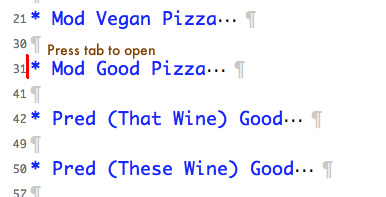
|
|
Place cursor to the left and click tab to open it.
|
|
|
|
2) You get a list of contexts for the test case. Keep the cursor where it was if you want to open everything at the same time. Alternatively, scroll down to one of the contexts and press tab there, if you only want to open one.
|
|
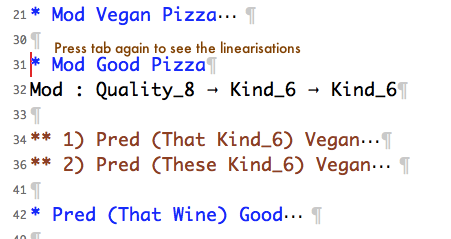
|
|
|
|
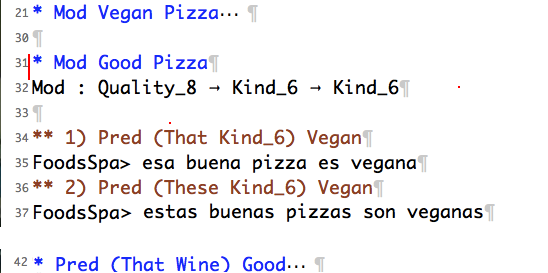
3) Now you can read the linearisations.
|
|
|
|
|
|
If you want to close the test case, just press tab again, keeping the
|
|
cursor where it's been all the time (line 31 in the pictures).
|
|
|
|
## Less common use cases
|
|
|
|
The topics here require some more obscure GF-fu. No need to worry if
|
|
the terms are not familiar to you.
|
|
|
|
|
|
### Empty or always identical fields: `-e`, `-q`
|
|
|
|
Information about the fields: always empty, or always equal to each
|
|
other. Example of empty fields:
|
|
|
|
```
|
|
> gftest -g Lang -l Dut -e
|
|
* Empty fields:
|
|
==> Ant: s
|
|
|
|
==> Pol: s
|
|
|
|
==> Temp: s
|
|
|
|
==> Tense: s
|
|
|
|
==> V: particle, prefix
|
|
```
|
|
|
|
The categories `Ant`, `Pol`, `Temp` and `Tense` are as expected empty;
|
|
there's no string to be added to the sentences, just a parameter that
|
|
*chooses* the right forms of the clause.
|
|
|
|
`V` having empty fields `particle` and `prefix` is in this case just
|
|
an artefact of a small lexicon: we happen to have no intransitive
|
|
verbs with a particle or prefix in the core 300-word vocabulary. But a
|
|
grammarian would know that it's still relevant to keep those fields,
|
|
because in some bigger application such a verb may show up.
|
|
|
|
On the other hand, if some other field is always empty, it might be a
|
|
hint for the grammarian to remove it altogether.
|
|
|
|
Example of equal fields:
|
|
|
|
```
|
|
> gftest -g Lang -l Dut -q
|
|
* Equal fields:
|
|
==> RCl:
|
|
s Pres Simul Pos Utr Pl
|
|
s Pres Simul Pos Neutr Pl
|
|
|
|
==> RCl:
|
|
s Pres Simul Neg Utr Pl
|
|
s Pres Simul Neg Neutr Pl
|
|
|
|
==> RCl:
|
|
s Pres Anter Pos Utr Pl
|
|
s Pres Anter Pos Neutr Pl
|
|
|
|
==> RCl:
|
|
s Pres Anter Neg Utr Pl
|
|
s Pres Anter Neg Neutr Pl
|
|
|
|
==> RCl:
|
|
s Past Simul Pos Utr Pl
|
|
s Past Simul Pos Neutr Pl
|
|
…
|
|
```
|
|
|
|
Here we can see that in relative clauses, gender does not seem to play
|
|
any role in plural. This could be a hint for the grammarian to make a
|
|
leaner parameter type, e.g. `param RClAgr = SgAgr <everything incl. gender> | PlAgr <no gender here>`.
|
|
|
|
|
|
### Unused fields: `-u`
|
|
|
|
These fields are not empty, but they are never used in the top
|
|
category. The top category can be specified by `-s`, otherwise it is
|
|
the default start category of the grammar.
|
|
|
|
Note that if you give a start category from very low, such as `Adv`,
|
|
you get a whole lot of categories and fields that naturally have no
|
|
way of ever making it into an adverb. So this is mostly meaningful to
|
|
use for the start category.
|
|
|
|
|
|
### Erased trees: `-r`
|
|
|
|
Show trees that are erased in some function, i.e. a function `F : A -> B -> C` has arguments A and B, but doesn't use one of them in the resulting tree of type C. This is usually a bug.
|
|
|
|
Example:
|
|
|
|
|
|
|
|
```
|
|
> gftest -g Lang -l "Dut Eng" -r
|
|
|
|
* Erased trees:
|
|
|
|
** RelCl (ExistNP something_NP) : RCl
|
|
- Tree: AdvS (PrepNP with_Prep (RelNP (UsePron it_Pron) (UseRCl (TTAnt TPres ASimul) PPos (RelCl (ExistNP something_NP))))) (UseCl (TTAnt TPres ASimul) PPos (ExistNP something_NP))
|
|
- Lin: ermee is er iets
|
|
- Trans: with it, such that there is something, there is something
|
|
|
|
** write_V2 : V2
|
|
- Tree: AdvS (PrepNP with_Prep (PPartNP (UsePron it_Pron) write_V2)) (UseCl (TTAnt TPres ASimul) PPos (ExistNP something_NP))
|
|
- Lin: ermee is er iets
|
|
- Trans: with it written there is something
|
|
```
|
|
|
|
In the first result, an argument of type `RCl` is missing in the tree constructed by `RelNP`, and in the second result, the argument `write_V2` is missing in the tree constructed by `PPartNP`. In both cases, the English linearisation contains all the arguments, but in the Dutch one they are missing. (This bug is already fixed, just showing it here to demonstrate the feature.)
|
|
|
|
## Detailed information about the grammar
|
|
|
|
### Debug information: `-d`
|
|
|
|
When combined with `-f`, `-c` or `-t`, two things happen:
|
|
|
|
1) The trees are linearised using `tabularLinearize`, which shows the
|
|
inflection table of all forms.
|
|
2) You can see traces of pruning that happens in testing functions:
|
|
contexts that are common to several concrete categories are put under
|
|
a separate test case.
|
|
|
|
When combined with `--show-cats`, also the concrete categories are
|
|
shown.
|
|
|
|
### --show-cats
|
|
|
|
Shows the categories in the grammar. With `--debug`/`-d`, shows also
|
|
concrete categories.
|
|
|
|
Example:
|
|
|
|
```
|
|
> gftest -g Foods -l Spa --show-cats -d
|
|
|
|
* Categories in the grammar:
|
|
Comment
|
|
Compiles to concrete category 0
|
|
Item
|
|
Compiles to concrete categories 1—4
|
|
Kind
|
|
Compiles to concrete categories 5—6
|
|
Quality
|
|
Compiles to concrete categories 7—8
|
|
Question
|
|
Compiles to concrete category 9
|
|
```
|
|
|
|
### --show-funs
|
|
|
|
Shows the functions in the grammar. (Nothing fancy happens with other flags.)
|
|
|
|
|
|
### --show-coercions
|
|
|
|
First I'll explain what *coercions* are, then why it may be
|
|
interesting to show them. Let's take a Spanish Foods grammar, and
|
|
consider the category `Quality`, e.g. `Good` and `Vegan`.
|
|
`Good` "bueno/buena/buenos/buenas" goes before the noun it modifies,
|
|
whereas `Vegan` "vegano/vegana/…" goes after, so these will become different
|
|
*concrete categories* in the PGF: `Quality_before` and
|
|
`Quality_after`. (In reality, they are something like `Quality_7` and
|
|
`Quality_8` though.)
|
|
|
|
Now, this difference is meaningful only when the adjective is modifying
|
|
the noun: "la buena pizza" vs. "la pizza vegana". But when the
|
|
adjective is in a predicative position, they both behave the same:
|
|
"la pizza es buena" and "la pizza es vegana". For this, the grammar
|
|
creates a *coercion*: both `Quality_before` and `Quality_after` may be
|
|
treated as `Quality_whatever`. To save some redundant work, this coercion `Quality_whatever`
|
|
appears in the type of predicative function, whereas the
|
|
modification function has to be split into two different functions,
|
|
one taking `Quality_before` and other `Quality_after`.
|
|
|
|
Now you know what coercions are, this is how it looks like in the program:
|
|
|
|
```
|
|
> gftest -g Foods -l Spa --show-coercions
|
|
* Coercions in the grammar:
|
|
Quality_7--->_11
|
|
Quality_8--->_11
|
|
```
|
|
|
|
(Just mentally replace 7 with `before`, 8 with `after` and 11 with `whatever`.)
|
|
|
|
### --show-contexts
|
|
|
|
Show contexts for a given concrete category, given as an FId
|
|
(i.e. Int). The concrete category may be a coercion or a normal
|
|
category. By combining with [`-s`](#start-category-for-context--s),
|
|
you can change the start category of the context.
|
|
|
|
(You can get a list of all concrete categories by pairing `--show-cats`
|
|
with `--debug`: see [`--show-cats`](#--show-cats).)
|
|
|
|
Examples:
|
|
|
|
* First, find out some concrete categories:
|
|
|
|
```
|
|
> gftest -g Foods -l Spa --show-cats -d
|
|
…
|
|
Quality
|
|
Compiles to concrete categories 7—8
|
|
…
|
|
```
|
|
|
|
* Then, list the contexts for some of them, say `Quality_7`:
|
|
|
|
```
|
|
> gftest -g Foods -l Spa --show-contexts 7
|
|
|
|
Pred (That (Mod ∅ Wine)) Vegan
|
|
Pred (That Wine) ∅
|
|
Pred (These (Mod ∅ Wine)) Vegan
|
|
Pred (These Wine) ∅
|
|
Pred (That (Mod ∅ Pizza)) Vegan
|
|
Pred (That Pizza) ∅
|
|
Pred (These (Mod ∅ Pizza)) Vegan
|
|
Pred (These Pizza) ∅
|
|
```
|
|
|
|
* Check out from [`--show-coercions`](#--show-coercions) how to find
|
|
coercions, and you can try `--show-contexts` with them:
|
|
|
|
```
|
|
> gftest -g Foods -l Spa --show-contexts 11
|
|
|
|
Pred (That Wine) ∅
|
|
Pred (These Wine) ∅
|
|
Pred (That Pizza) ∅
|
|
Pred (These Pizza) ∅
|
|
```
|
|
|
|
### --count-trees
|
|
|
|
Number of trees up to given size. Gives a number how many trees, and a
|
|
couple of examples from the highest size. Examples:
|
|
|
|
```
|
|
> gftest -g TestLang -l Eng --count-trees 10
|
|
There are 675312 trees up to size 10, and 624512 of exactly size 10.
|
|
For example:
|
|
* AdvS today_Adv (UseCl (TTAnt TPres ASimul) PPos (ExistNP (UsePron i_Pron)))
|
|
* UseCl (TTAnt TCond AAnter) PNeg (PredVP (SelfNP (UsePron they_Pron)) UseCopula)
|
|
```
|
|
|
|
This counts the number of trees in the start category. You can also
|
|
specify a category:
|
|
|
|
```
|
|
> gftest -g TestLang -l Eng --count-trees 4 -s Adv
|
|
There are 2409 trees up to size 4, and 2163 of exactly size 4.
|
|
For example:
|
|
* AdAdv very_AdA (PositAdvAdj young_A)
|
|
* PrepNP above_Prep (UsePron they_Pron)
|
|
```
|
|
|
|
### --funs-of-arity
|
|
|
|
Show all functions of given arity (not up to).
|
|
|
|
Example:
|
|
|
|
```
|
|
> gftest -g Phrasebook --funs-of-arity 3
|
|
* Functions in the grammar of arity 3:
|
|
ADoVerbPhrasePlace
|
|
AModVerbPhrase
|
|
HowFarFromBy
|
|
QWhereModVerbPhrase
|
|
```
|